



So,
you've been hearing in the news how great solar panels are and you
wonder if they are right for your home, business or project.
Obviously, you have many questions. Hopefully by clicking on the
following links you can find some answers. Also, contact
EnReDs
with questions on your specific applications.
What are photovoltaics (solar panels) ?
a) How do solar panels work?
b) What technologies are available?
How reliable are solar panels?
Can I afford solar panel technology?
The
following sections are an attempt to help you answer these
questions.
What
are photovoltaics (solar panels)?
In
short, photovoltaic devices turn light into electricity. Typically
these devices are made into panels in large numbers in such a way
that they can catch sunlight. Thus photovoltaics are more commonly
known as solar panels. These solar panels are then arranged into
arrays to further increase the electrical power available. The
photovoltaic arrays are then combined with batteries, the electrical
grid or other energy storage devices to form a photovoltaic system.
Solar cells were first developed in 1954 and since then have evolved
substantially. Some important principles on how photovoltaics work
and a brief overview of the technologies available will be presented
in this section.
How
do photovoltaics work?:
Photovoltaics
turn light into electricity by using the same electroluminescent
phenomenon as light emitting diodes (LEDs), but in the reverse
direction. In fact, solar cells are also diodes that emit
electrons when light interacts with them. Solar cells are made of
special materials called semiconductors. The performance of the
solar cell is directly dependent on the semiconductor materials used
and how they are configured. The most common semiconductor used in
solar cells is silicon, although there are many other semiconductor
technologies available. A specific semiconductor material and
configuration will make solar cells that will generate electricity
only when specific colors of light hit the device. If the light that
hits the solar cell is not of the right color, the light will either
pass through the solar cells without being absorbed or it will be
partially absorbed by the material and generate heat. Thus the
conversion efficiency of a solar cell is defined by the portion of
light colors it uses from all the light colors available from the
sun. Thus the many photovoltaic technologies available in the market
come from the effort of making solar cells that will use as much of
the sun light colors as possible. The more complex and exotic the
configuration and materials the greater the conversion efficiency
and price of the technology. Because of their availability,
efficiency, and technological maturity, the arguments in this
article will only focus around monocrystalline silicon solar
panels.
What
solar panel technologies are available?
A
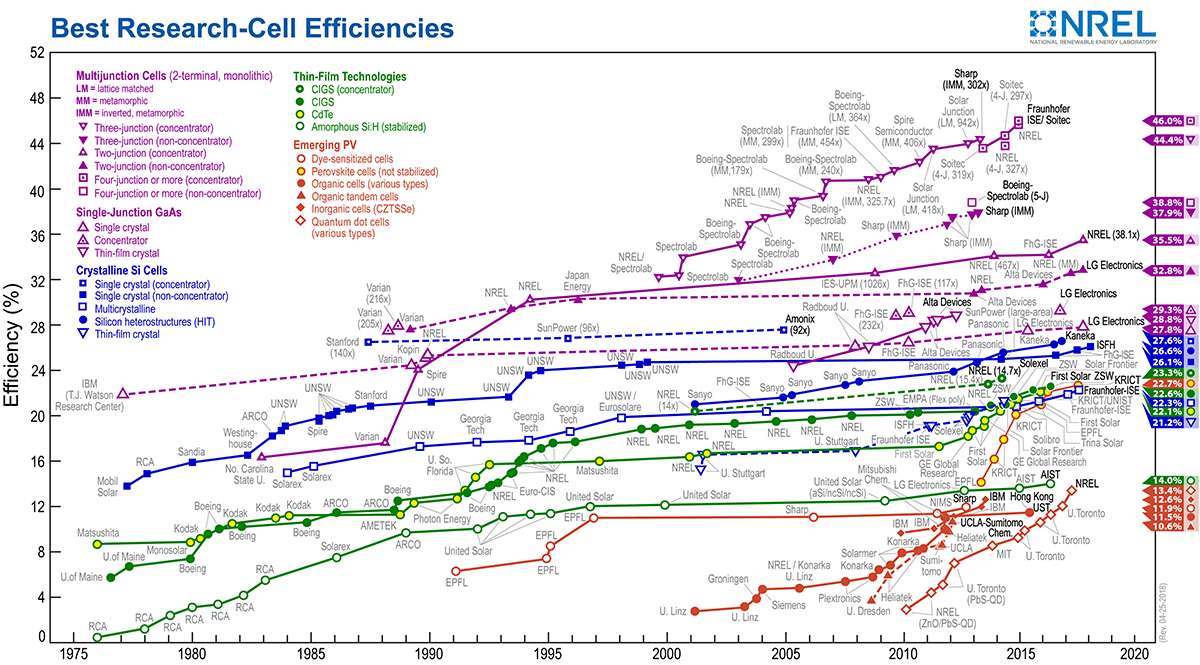
chart compiled and published by the
National Renewable Energy Laboratory (NREL) explains the state of
the art of the many photovoltaic technologies. In this chart the
purple technologies use more complex and exotic semiconductor
materials. These are the technologies used to power satellites
and in comparison to other technologies they are the costliest to
produce. These solar cells have the greatest energy conversion
potential. The blue technologies in the chart are the popular
silicon based solar cells used in most residential and commercial
applications. These technologies are very close to their ideal 30%
theoretical maximum efficiency, which indicates that the technology
is mature. The technologies in green are thin-film technologies.
This means that they are designed to be printed, deposited or glued
instead of being made out of a substrate carrier material. These
solar cells are physically very versatile as some of them can be
flexible, others can be integrated onto substrates such as roof
tiles and other yet can be produced in very large quantities.
However their low conversion efficiency means that they require
larger amounts of real estate to produce as much power as silicon
cells. The technologies in orange are for the most part in the
research stage or have been developed with very specific
applications in mind.
There are many available
photovoltaic technologies to choose from ENREDS
can help you choose the best one for your application.
How
reliable are solar panels?
The
sun, solar panels, inverters, installation,
batteries and the maintenance of the photovoltaic system are all
factors that determine its reliability. PV systems are an investment
and as any investment you want to know whether you will get the
maximum power possible out of the system. Hopefully, the following
questions can help you in making choices that will deliver the
maximum reliability from your system.
Is
the PV system in a reliable location?
The
first factor to consider is the sun. Not to say that the sun is not
reliable, after all it rises every morning, but the question is how
much of its power gets to the panels?. It might be that the PV
system is going to be at the north pole where it only gets light
from the sun half of the year. Or it could be that the city where
the PV system is installed is too polluted. To have a reliable PV
system the first question one has to answer is, "Is the PV
system going to be installed in a reliable location?." There is
no simple answer to this question. Thankfully, at ENREDS
we have models that can provide an idea on how reliable the location
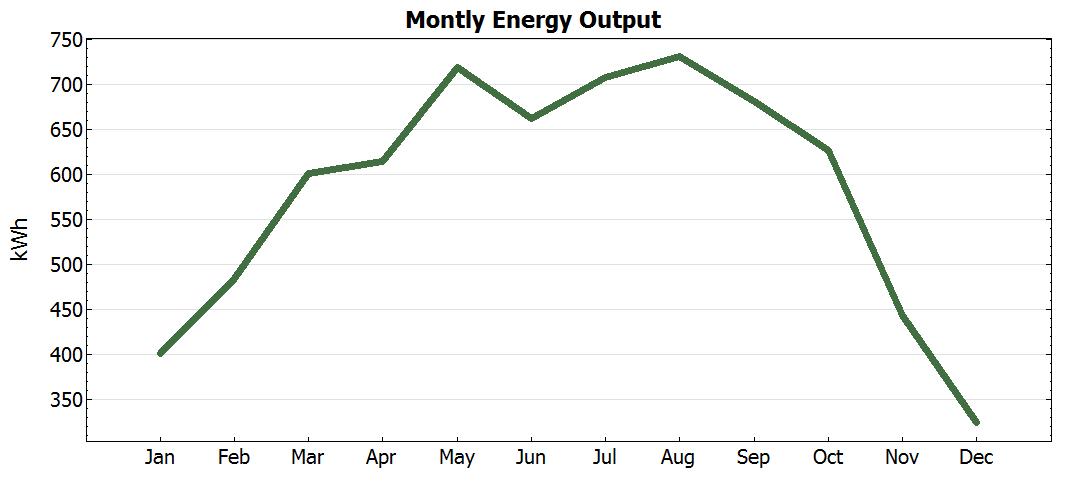
of your project is. Take for example a typical household
in Salt Lake City with a 5 kilowatt monocrystalline silicon PV array
connected to the electrical grid. The figure below shows the
calculated energy production for such an array through out the year
based on NREL data. The graph shows that during the winter months
the production of the PV system sharply decreases due to its
location. An important implication of this graph is that an
alternate source of energy might be required in the winter for
residential heating purposes. However PV power is fully available in
the summer when air conditioning systems are in full force, and it
is during these hot months when solar panel can provide the largest
savings.
Is
the PV system reliable?
A
second factor to consider is of course the photovoltaic system
itself. Since for the most part PV systems don't have a lot of
moving parts they have the potential to last for a long time.
However, PV systems have to withstand extreme temperature and
environmental stresses. How well the PV system will withstand these
stresses is determined by the quality of the system, the maturity of
the technology being used and the maintenance given. According to
NREL testing data, a 5 kW system similar to the example above should
suffer about 5% decay in efficiency every decade. Typically a
reputable solar panel manufacturer standard guarantee should be for
at least 5 years. There are hundreds of PV system
manufacturers and installers. ENREDS can design PV array systems,
provide guidance in selecting good quality photovoltaic systems and
suggest contractors to install them. The following figure is the
calculated yearly output of the example 5 kW system.

Can
I afford PV technology?
This
article will use three factors to determine how affordable a
PV array system can be in light of our 5 kW example system. The
first factor is the out of pocket initial cost of the system. The
second factor is the energy savings the systems provides. And the
third factor is the value added by the system to the real estate
where it is installed. For the purposes of this discussion these
three factors were calculated using NREL data.
There are
several costs associated with installing a photovoltaic system. The
following chart summarizes most of the linearized costs of energy
(LCOE) associated with installing the ideal 5 kW example
photovoltaic system. Given all these costs, the example 5 kW
photovoltaic system would cost about $27,670 dollars to install
based on 2012 prices. Most of the costs on this graph are subject to
either stay the same or most likely go up, as is the labor, taxes,
fees, etc... However, the one potential cost that is projected to go
down is the cost of the solar panels.
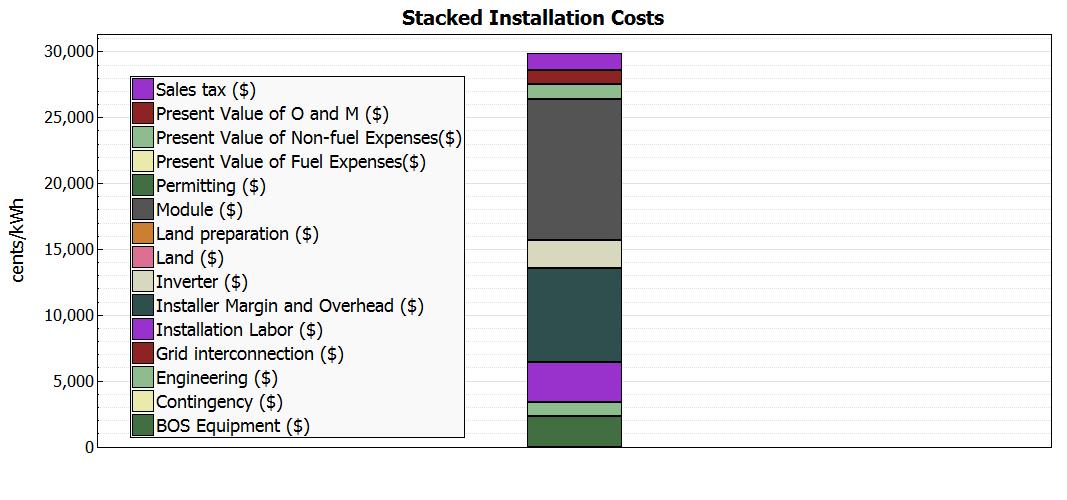
From
this
graph
one
can observe that the cost of the solar panels themselves is about
40% of the total cost of the energy. The costs for these solar
panels is projected to decrease as panel manufacturing capacity
increases. The following graph is the historical and projected cost
of the 5 kW example system.

While
the cost of the solar panels is expected to decrease, the question
of whether to wait to purchase a PV system until the prices go down
arises. To answer this question consider that in order to save
$2,000 one would have to wait five more years. Then, the next
question is, how much money can be saved during those five years if
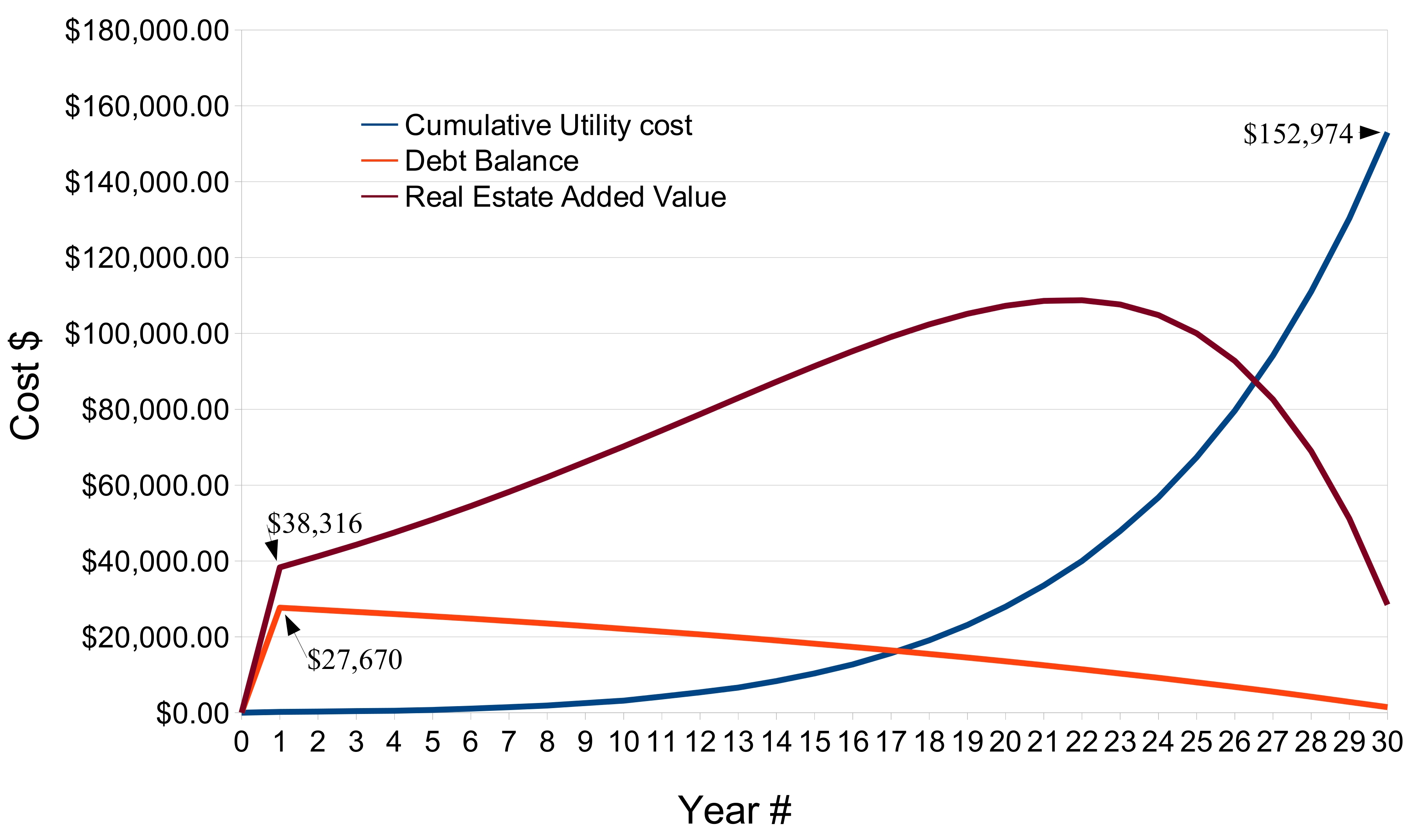
the PV system is installed now? The figure bellow shows the
projected cumulative utility cost calculated using NREL data.The
cumulative utility cost is the price of all the energy used in a
certain period of time if it were purchased from the power company.
In five years this cumulative cost is ~$740. Furthermore, the
projected instant value added to the real estate where the panels
are installed is almost $11,000. Not counting the fact that in five
years labor costs will go up and tax incentives will go away.
Investing in a PV system now might be an intelligent move. An
additional point of interest in the graph bellow is that in five
years the PV system would have added about $60,000 of additional
property value in addition to the energy savings. And, over 30 years
the PV systems would have provided over $125,000 in energy savings
and close to $100,000 in added property value.
Photovoltaics (Solar Panels) FAQ